
OSU Extension Service Master Gardeners™ are volunteer educators, neighbors, and on-the-ground researchers who serve their community with solid training in science-based, sustainable gardening and a love of lifelong learning.
2026
Chapter Calendar
& Lecture Series
Our popular Lecture Series happens on the second Monday of the month from October to June. We also offer two educational events during the year along with our annual Spring Garden Fair in May. Please join us!
- January 12: Lecture -Dryland Farming – a presentation by Sally Campbell and Marilyn Frankel
- February 9: Lecture – The Use of Raw Wool Pellets as Soil Amendments presented by Timothy Fulmer
- March 9: Lecture – Pheromone Traps and Lures for Insect Pest Management presented by Dr. Darek Czokajlo
- March 21: Garden Discovery Day – 9am – noon
- April 13: Lecture – A talk about Fuchsia’s – a presentation by Theo Margelony
- May 2 & 3: Spring Garden Fair @ Clackamas County Event Center
- May 11: Lecture – Microbiomes on Fresh vs Store Bought Fruits and Vegetables presented by Gwynne Mhuireach
- June 8: Lecture – Bees and Pollination – a presentation by Dewey Caron
- October 10: Fall into Gardening – 9am – noon
- October 12: Lecture – Hot Topics in Vegetable Gardening – a presentation by Chip Bubl
- November 9: Lecture – Microplastics in Garden Soil presented by Anna Perry
- December 14: Greens & Gather: A Holiday Workshop
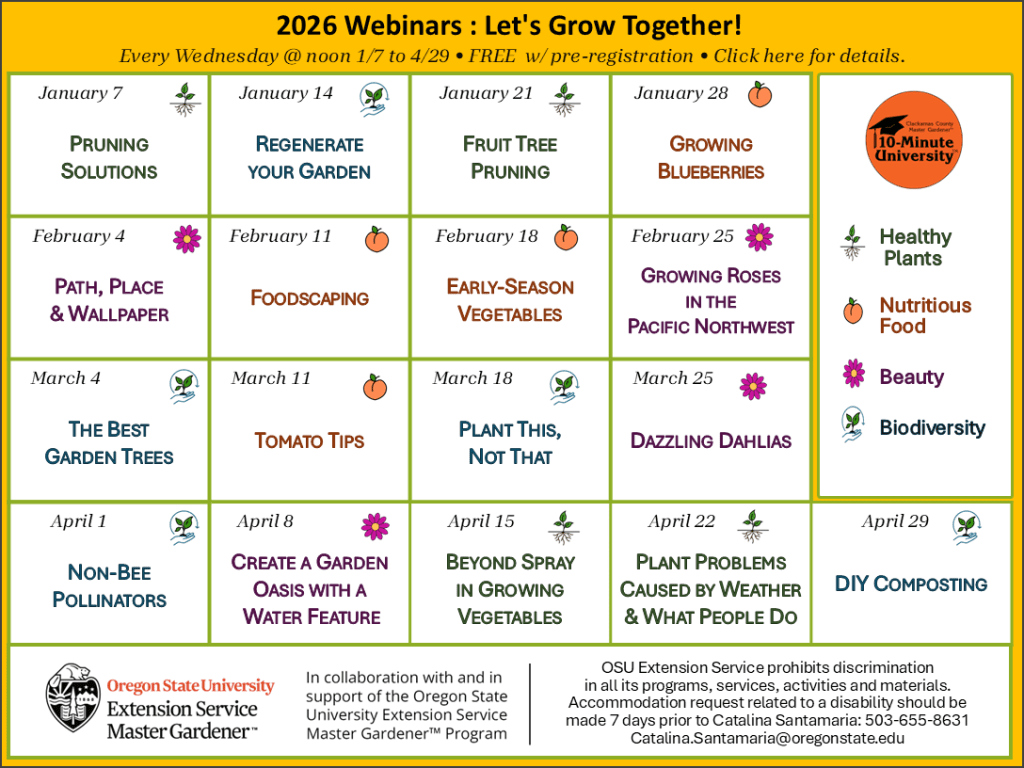
2026 Webinars Premier on January 7!
Sign Up Links are live now for January & February .
Save the date! May 2 & 3, 2026 at the Clackamas County Fairgrounds in Canby.
Find & Follow us on Facebook
Metro Area | Washington County | Clackamas County | Multnomah County

The Clackamas County Master Gardener™ Association in collaboration and in support of Oregon State University Extension Service. OSU Extension Service prohibits discrimination in all its programs, services, activities and materials on the basis of race, color, national origin, religion, sex, gender identity (including gender expression), sexual orientation, disability, age, marital status, familial/parental status, income derived from a public assistance program, political beliefs, genetic information, veteran’s status, reprisal or retaliation for prior civil rights activity. (Not all prohibited bases apply to all programs.)

 Clackamas County Master Gardener™ Association